
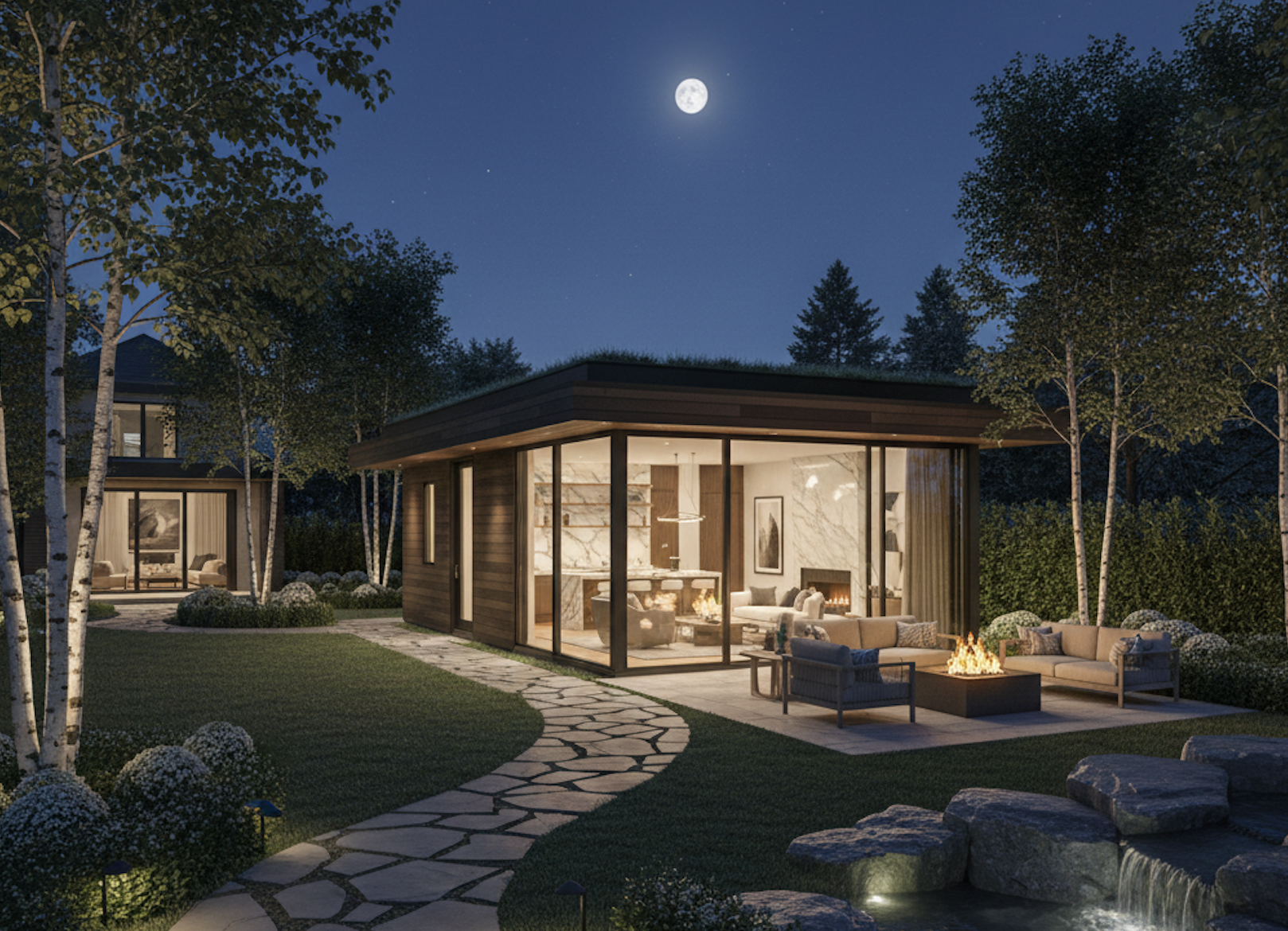
The Backyard Housing Revolution
Something significant is happening in Barrie's backyards. Across the city, homeowners are discovering that the empty space behind their homes could be worth $2,000+ per month in rental income—or provide housing for aging parents, adult children, or a home-based business.
This isn't speculation. It's policy.
The federal Housing Accelerator Fund (HAF) has injected over $4 billion nationally to municipalities that commit to building more homes faster. In exchange for funding, cities like Barrie are eliminating barriers to "gentle density"—and garden suites are at the center of this shift.
Why Garden Suites Are the Opportunity of 2026:
- •Rental income potential: 1-bedroom units in Barrie rent for $1,332/month; 2-bedrooms average $1,537/month
- •Multigenerational living: Keep aging parents close while maintaining independence
- •Property value increase: A legal garden suite can add $100,000–$200,000 to your property value
- •Reduced development fees: Many municipalities are waiving or reducing fees as part of HAF commitments
But here's the problem: most homeowners don't even know what a garden suite is—or how it differs from a coach house, laneway home, or ADU. The terminology is confusing, the regulations are changing fast, and misinformation is everywhere.
Source: CMHC Housing Accelerator Fund; Simcoe County Average Market Rent Survey
$4+ billion — Federal Housing Accelerator Fund investment to speed up housing across Canada
Garden Suite vs Coach House vs Laneway Home: What's the Difference?
This is where most homeowners get confused—and understandably so. The terms are used interchangeably online, but they have specific meanings in Ontario planning law.
Garden Suite (Additional Residential Unit - Detached)
The official term in Ontario planning documents. A garden suite is: - A self-contained dwelling unit separate from the main house - Located in the rear yard of a residential property - Has its own entrance, kitchen, bathroom, and sleeping area - Cannot be severed or sold separately from the main property
Coach House
Historically, a coach house was a building for storing horse-drawn carriages. Today, the term is used interchangeably with garden suite, but it often implies: - A two-storey structure (living space above a garage) - May include parking or storage at ground level - Popular in urban areas where lot coverage is maximized
Laneway House
A specific type of garden suite that: - Fronts onto a rear laneway or alley - Has vehicle access from the lane (not the main street) - Common in older neighbourhoods with established lane networks - Note: Barrie has limited laneway infrastructure compared to Toronto
Accessory Dwelling Unit (ADU)
This is the umbrella term that includes all secondary housing on a property: - Basement apartments (attached ADU) - Garden suites (detached ADU) - Above-garage apartments - Coach houses
The Key Distinction in Barrie:
Under current bylaws, Barrie recognizes two types of Additional Residential Units (ARUs): 1. Attached ARU: A second unit within or attached to the main dwelling (e.g., basement apartment) 2. Detached ARU: A separate structure on the same lot (e.g., garden suite)
Source: Ontario Ministry of Municipal Affairs and Housing; City of Barrie Zoning By-law
When searching for contractors, use "garden suite" or "detached ARU" for Ontario-specific results. "ADU" returns mostly American content.
2026 Barrie Bylaws & the Housing Accelerator Fund
The regulatory landscape for garden suites has transformed dramatically since 2022. Here's what's changed and why it matters for Barrie homeowners.
Bill 23: More Homes Built Faster Act (2022)
This provincial legislation was a game-changer. It required all Ontario municipalities to permit: - Up to 3 residential units on most residential lots as-of-right - This means: main house + basement suite + garden suite = 3 units, no rezoning required - Municipalities cannot impose minimum lot sizes or parking requirements that would prevent ARUs
The Housing Accelerator Fund Impact
Barrie signed onto the HAF with commitments to: - Streamline permit approvals for ADUs and garden suites - Reduce or waive development charges for affordable housing units - Update zoning bylaws to remove barriers to gentle density - Speed up building permit timelines
Current Barrie Zoning Requirements for Garden Suites:
| Requirement | Specification |
|---|---|
| Maximum Size | Lesser of 50% of main dwelling OR 80 sq.m (861 sq.ft) |
| Maximum Height | 6.0 metres (single storey) or match main dwelling |
| Rear Yard Setback | 1.2 metres minimum |
| Side Yard Setback | 1.2 metres minimum |
| Lot Coverage | Combined structures cannot exceed zoning maximum |
| Parking | No additional parking required for ARU |
What This Means Practically:
- •If you have a standard 50-foot lot in Barrie, you likely qualify
- •No public hearings or rezoning applications required
- •Permits are administrative (staff approval, not council)
- •Timeline from application to approval: 4-8 weeks (faster than historical 6+ months)
Source: Ontario Bill 23; City of Barrie Official Plan; CMHC Housing Accelerator Fund
Up to 3 units now permitted as-of-right on most Barrie residential lots under Bill 23
Building Code & Zoning Requirements
Building a garden suite isn't just about zoning—you need to meet the Ontario Building Code requirements for a standalone dwelling. Here's what's required.
Ontario Building Code Requirements:
Foundation & Structure - Must be designed by a licensed engineer or architect (for most municipalities) - Foundation options: concrete slab, frost-protected shallow foundation, or helical piles - Structure must meet current energy efficiency requirements (SB-12)
Ceiling Height - Minimum 2.1 metres (6'11") in habitable rooms - Most designs target 8-9 foot ceilings for comfort
Fire Separation - If within 3 metres of the main dwelling: fire-rated construction required - Minimum 1-hour fire resistance rating for walls facing the main house - Non-combustible cladding may be required depending on proximity
Egress Requirements - Every bedroom requires an egress window (same specs as basement suites) - Minimum 0.35 sq.m opening area - Alternative: direct exterior door access from bedroom
Electrical - Separate electrical panel (100-amp minimum typical) - May require service upgrade to main property if capacity insufficient - Interconnected smoke and CO alarms required
Plumbing & HVAC - Separate water heater (tank or tankless) - Independent heating system (mini-split heat pump most common) - HRV (Heat Recovery Ventilator) required for energy efficiency compliance
Accessibility Considerations:
Under AODA and OBC requirements, consider: - Zero-step entry (required for aging-in-place) - 36-inch doorways for wheelchair accessibility - Accessible bathroom layout if intended for elderly family members
Source: Ontario Building Code 2024, Division B, Part 9; AODA Design of Public Spaces Standards
Garden suites within 3m of the main house require fire-rated construction. Factor this into your site planning.
Cost Breakdown: Prefab vs Custom Garden Suites
Let's talk real numbers. Garden suite costs vary dramatically based on your approach, and understanding the options helps you budget accurately.
Option 1: Prefab/Modular Garden Suite
Factory-built units delivered and installed on your property.
Pros: - Faster construction (8-12 weeks vs 4-6 months) - Fixed pricing with fewer surprises - Quality control in factory environment - Minimal site disruption
Cons: - Limited customization options - Access requirements (crane delivery) - May not maximize your lot's potential - Design limitations based on transport size
Typical Prefab Costs (Barrie area):
| Unit Size | Price Range (Turnkey) |
|---|---|
| 400 sq.ft (1-bed) | $180,000 – $250,000 |
| 600 sq.ft (1-bed+) | $220,000 – $300,000 |
| 800 sq.ft (2-bed) | $280,000 – $380,000 |
Option 2: Custom-Built Garden Suite
Traditional stick-built construction on your property.
Pros: - Fully customizable design - Can maximize lot configuration - Higher-end finishes available - Better integration with existing landscaping
Cons: - Longer timeline (4-8 months typical) - More variables in final cost - Weather dependencies - Greater site disruption
Typical Custom Build Costs (Barrie area):
| Unit Size | Price Range |
|---|---|
| 400 sq.ft | $200,000 – $280,000 |
| 600 sq.ft | $260,000 – $350,000 |
| 800 sq.ft | $320,000 – $450,000+ |
Detailed Cost Breakdown (600 sq.ft unit):
| Component | Prefab | Custom |
|---|---|---|
| Unit/Construction | $150,000 – $200,000 | $180,000 – $250,000 |
| Foundation | $15,000 – $25,000 | $20,000 – $35,000 |
| Site Prep & Excavation | $5,000 – $10,000 | $8,000 – $15,000 |
| Servicing (water/sewer) | $20,000 – $40,000 | $20,000 – $40,000 |
| Electrical Connection | $5,000 – $10,000 | $5,000 – $10,000 |
| Permits & Fees | $3,000 – $8,000 | $3,000 – $8,000 |
| Landscaping Restoration | $5,000 – $15,000 | $8,000 – $20,000 |
The ROI Calculation:
At $1,500/month rental income: - Annual income: $18,000 - A $280,000 investment pays back in approximately 15-16 years - But: property value increases immediately by $100,000-$200,000 - Net effective payback: 8-10 years
Source: Ontario prefab manufacturer pricing; GTA construction cost surveys; CMHC rental market data
Servicing costs ($20,000-$40,000) are often the hidden budget-buster. Get a site servicing quote before finalizing your budget.
Water, Sewer & Utility Connections
This is the section most homeowners overlook—and where budgets often blow up. Connecting your garden suite to municipal services is complex and expensive.
Water Connection Options:
Option A: Extend from Main House - Run water line from main house to garden suite - Requires excavation and potentially boring under driveways/patios - Cost: $8,000 – $15,000 - Pros: Simpler permit process - Cons: Shared water meter, potential pressure issues
Option B: Separate Municipal Connection - New water service from the street - Requires road cut permit and municipal coordination - Cost: $15,000 – $30,000+ - Pros: Independent metering, better resale positioning - Cons: Significantly higher cost, longer timeline
Sewer Connection Options:
Gravity Sewer (Best Case) - If your lot slopes toward the street, gravity connection is possible - Tie into existing lateral or install new connection - Cost: $10,000 – $20,000
Pump System (Common Scenario) - If garden suite is lower than sewer line, a grinder pump is required - Pump stations cost: $5,000 – $10,000 installed - Ongoing maintenance required - Cost: $15,000 – $30,000 total
Septic Considerations (Rural Simcoe County) - Properties outside municipal sewer need separate septic assessment - May require enlarged septic system or separate system - Cost: $25,000 – $50,000 for new septic field
Electrical Service:
- •Most garden suites need 100-amp service minimum
- •If your main panel is maxed, an upgrade may be required
- •Main panel upgrade: $3,000 – $5,000
- •New underground service to garden suite: $3,000 – $8,000
- •Total electrical: $6,000 – $13,000
Natural Gas (Optional):
- •If using gas heating/cooking: $3,000 – $6,000 for connection
- •Most new builds use electric heat pumps instead (no gas required)
Pre-Construction Site Assessment:
Before committing to a garden suite project, you need: 1. Lot grading survey: Determines drainage and sewer options 2. Utility locates: Identifies existing underground services 3. Servicing feasibility study: Engineering assessment of connection options
Source: Barrie municipal servicing requirements; Ontario Building Code Part 7
Always get a servicing feasibility assessment before signing a contract. A $300,000 garden suite on a lot that requires a $50,000 pump system changes the math significantly.
The Build Process: Start to Finish
Here's what the complete garden suite journey looks like in Barrie, from first thought to first tenant.
Phase 1: Feasibility (2-4 weeks)
Before spending significant money, determine if a garden suite makes sense for your property.
- •Site assessment: Lot size, setbacks, access, grading
- •Zoning verification: Confirm your property qualifies under current bylaws
- •Servicing review: Water, sewer, electrical capacity
- •Budget alignment: Does the investment make sense for your goals?
Phase 2: Design (4-8 weeks)
Once feasibility is confirmed, move to design.
- •Architectural drawings: Floor plans, elevations, site plan
- •Engineering: Structural, if required by your municipality
- •Energy compliance: SB-12 energy efficiency documentation
- •Servicing design: Detailed utility connection plans
Phase 3: Permits (4-8 weeks)
Submit your application to the City of Barrie.
- •Building permit application: Complete drawings and specifications
- •Site plan approval: If required (most residential garden suites exempt)
- •Servicing permits: Water, sewer, electrical connections
- •Review and approval: Municipal staff review
Phase 4: Construction (Prefab: 2-3 months / Custom: 4-6 months)
With permits in hand, construction begins.
Prefab Timeline: - Week 1-2: Site prep, foundation installation - Week 3-8: Factory manufacturing (concurrent) - Week 9: Delivery and crane placement - Week 10-12: Connections, finishing, inspections
Custom Build Timeline: - Week 1-3: Excavation, foundation - Week 4-8: Framing, roofing, exterior - Week 9-14: Mechanical, electrical, plumbing - Week 15-20: Insulation, drywall, finishing - Week 21-24: Final finishes, inspections
Phase 5: Inspections & Occupancy (2-4 weeks)
Final steps before move-in.
- •Municipal inspections: Building, electrical, plumbing, HVAC
- •Utility connections: Final hookups and meter installation
- •Occupancy permit: Official approval to inhabit
- •Final walkthrough: Contractor handover
Total Timeline Summary:
| Approach | Best Case | Typical | Complex |
|---|---|---|---|
| Prefab | 5 months | 6-7 months | 9+ months |
| Custom | 7 months | 9-12 months | 14+ months |
Source: City of Barrie building permit timelines; Ontario builder associations
Start the permit process in fall/winter. By the time approvals come through, you'll be ready for spring construction when weather cooperates.
Next Steps
If you're considering a garden suite for your Barrie or Simcoe County property, here's the path forward.
Step 1: Free Feasibility Call
Book a 15-minute call with our team. We'll discuss: - Your property's basic characteristics - Your goals (rental income, family housing, etc.) - Rough budget alignment - Whether a full site assessment makes sense
Step 2: Site Assessment
If a garden suite looks viable, we conduct a comprehensive property assessment: - Lot survey and measurements - Utility location and capacity - Grading and drainage analysis - Zoning compliance verification - Preliminary servicing cost estimate
Step 3: Design Options
Based on the assessment, we present options: - Prefab vs custom recommendations - Unit size and layout options - Budget ranges for each approach - Timeline estimates
Step 4: Detailed Proposal
If you're ready to proceed: - Complete architectural drawings - Itemized construction budget - Servicing and permit cost breakdown - Construction timeline - Payment schedule
Why Work With a Specialist?
Garden suites are different from basement conversions or home additions. They require: - Understanding of detached building codes - Relationships with prefab manufacturers - Servicing and excavation expertise - Experience with municipal permit processes
Our Garden Suite Experience:
We've helped Barrie-area homeowners navigate the garden suite process from first call to final inspection. We know the local bylaws, the permit reviewers, and the real costs involved.
Ready to explore your backyard's potential?
Contact us for a free feasibility call. No pressure, no commitment—just honest answers about whether a garden suite makes sense for your property.
Reno Raptors Team
Barrie's trusted renovation experts with 75+ projects completed